After Hurricane Helene hit western North Carolina in September 2024, 803,000 Duke Energy customers lost power. Some got it back within days. Thousands in the mountain counties waited more than two weeks. Roads were washed out. Propane deliveries couldn’t reach remote areas. Cell towers were down.
That event changed how a lot of NC homeowners think about backup power. The question used to be whether backup power was worth the cost. Now it’s which kind makes sense for your situation.
Battery backup vs. generator: the quick comparison
A standby generator gives you essentially unlimited runtime as long as fuel is available. It handles large loads, whole-home coverage, and extended outages.
A solar battery gives you silent, automatic, fuel-free backup. Runtime is limited by capacity, but solar recharging extends that meaningfully during daylight hours. Duke Energy’s PowerPair program may reduce upfront cost for qualifying solar-plus-battery projects only when Duke confirms capacity or a reservation.
Neither is right for every household. The choice comes down to your location, how long your typical outages run, your budget, and whether you have (or want) solar.
What a solar battery covers vs. what a generator covers
Standby generators
A standby generator sits outside on a concrete pad, connects to your natural gas or propane line, and starts automatically within seconds of a grid outage. You don’t have to be home. You don’t have to do anything.
A 10 kW unit handles the essentials: lights, refrigerator, fans, phone charging, and a small window AC. A 22 kW unit can run your whole home including central air conditioning, electric water heater, and EV charger simultaneously.
The Generac 22kW Guardian runs around $10,000-$15,000 installed, including the automatic transfer switch. It burns propane at 3.9 gallons per hour at full load. A 500-gallon propane tank holds about 400 usable gallons (tanks fill to 80% for expansion safety), which costs roughly $1,332 to fill at current NC prices of $3.33/gallon. At full load that’s about 100 hours of runtime, or longer if you’re not running everything at once.
Natural gas is cheaper per BTU and refills automatically, but natural gas lines don’t reach every NC address. Rural counties in the mountains and eastern coastal plain often have no pipeline access. If you’re in one of those areas, propane is your only option for a gas standby generator.
Home batteries
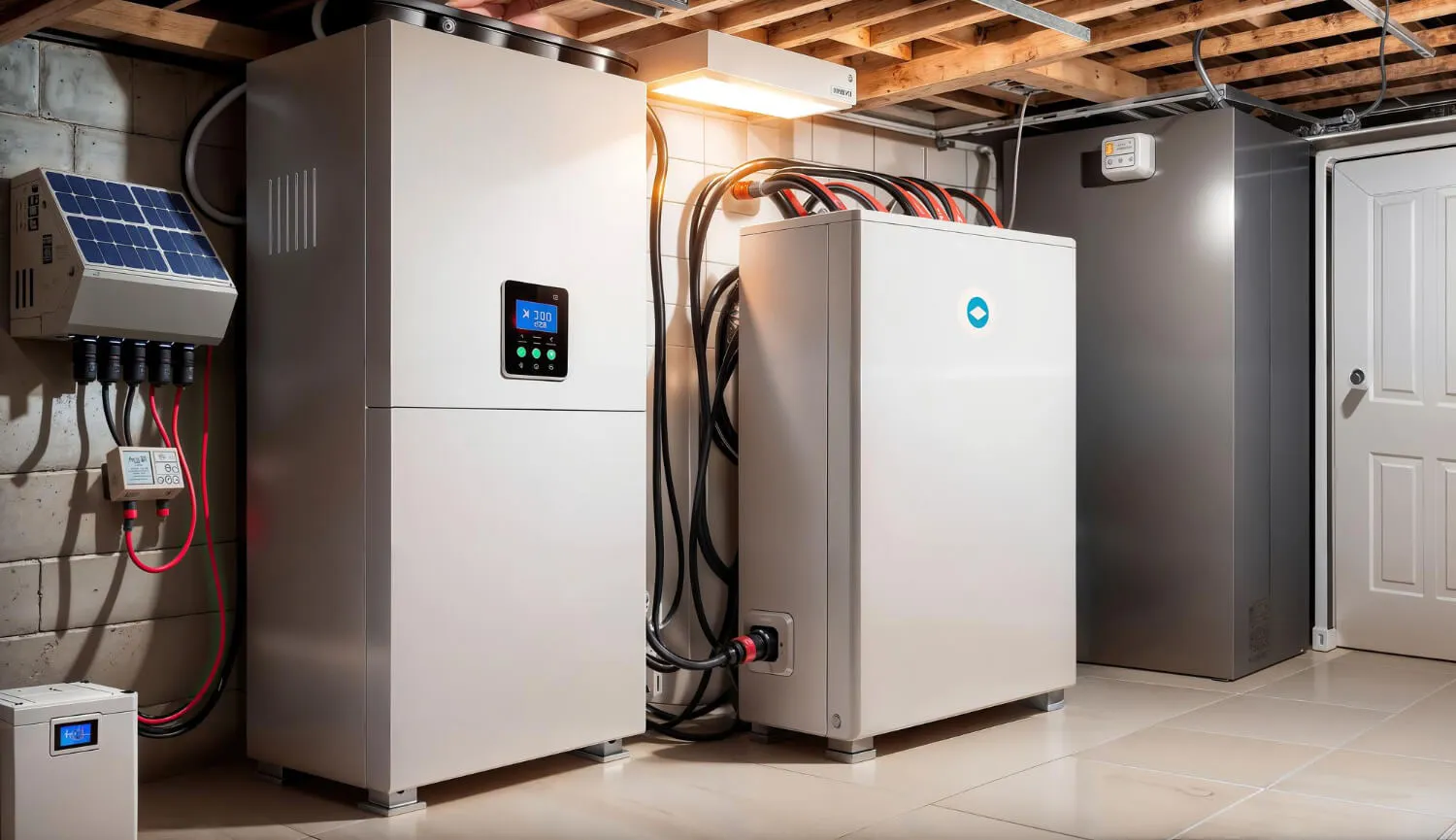
A home battery charges from your solar panels or from the grid at off-peak rates. When the grid goes out, it switches over automatically, usually in under a second, with no startup time and no noise.
The Tesla Powerwall 3 is the most widely installed option in NC. It holds 13.5 kWh of usable capacity and delivers 11.5 kW continuous output, enough to run a typical home’s essential circuits. The built-in inverter accepts up to 20 kW of solar DC input directly. Installed cost in NC averages $13,000-$18,000 before incentives (per EnergySage NC market data).
The FranklinWH aPower 2 holds 15 kWh per unit at 10 kW continuous output. The Enphase IQ Battery 5P holds 5 kWh per unit and works well if you’re already on Enphase solar microinverters. Most homeowners with Enphase systems install two or more units for meaningful whole-home coverage.
Cost comparison
| Generac 22kW Standby | Tesla Powerwall 3 | Portable (Honda EU7000iS) | |
|---|---|---|---|
| Installed cost | $10,000-$15,000 | $13,000-$18,000 | ~$6,500 with transfer switch |
| PowerPair incentive | None | Up to $5,400 (with solar) | None |
| Annual fuel/maintenance | $200-$600 maintenance | ~$0 | $100-$200 |
| Propane cost per outage | $130-$930+ (1-3 days at full load) | $0 | $3-6/hour in gasoline |
| Noise | ~67 dB at 23 ft | Silent | 52-58 dB |
After the Duke Energy PowerPair incentive, a Powerwall 3 installed with solar can cost less than a comparable standby generator, depending on system size.
A portable generator is cheaper upfront but requires manual setup, can’t start automatically, and produces carbon monoxide that kills people who use them indoors or in garages. It’s a bridge solution, not a long-term one.
How long each option lasts
This is where the two options differ most.
A standby generator on natural gas runs until you turn it off or the gas company has a problem. On propane, you’re limited by your tank. A 500-gallon tank at partial load (running lights, refrigerator, and occasional AC) might last 5-10 days before needing a fill.
In western NC after Helene, fill-ups weren’t happening for weeks in some areas. Homeowners who had 1,000-gallon tanks fared better than those with 250-gallon tanks. But if roads were cut off, tank size didn’t matter.
A battery’s runtime depends on how much you’re drawing:
| Load scenario | Powerwall 3 runtime (no solar recharge) |
|---|---|
| Essential loads only (~1 kW: fridge, lights, Wi-Fi) | 12-13 hours |
| Essential loads + one window AC (~2.5 kW) | 5-6 hours |
| Essential loads + central AC (~5 kW) | 2-3 hours |
| Full home draw (~10 kW) | ~1.5 hours |
With solar recharging on a clear day, a 5 kW solar array adds roughly 20-30 kWh of energy, which can fully replenish a Powerwall and then some. Cloudy days are less predictable. For multi-week coverage without sun, a single battery isn’t enough.
The Helene scenario: why fuel security matters
The standard generator argument is that batteries run out and generators don’t. That’s largely true.
But Helene added a wrinkle. In Buncombe, Rutherford, McDowell, and Avery counties, propane delivery trucks couldn’t reach large parts of the service area for weeks. Roads were gone. Homeowners with propane generators had a tank’s worth of backup and then nothing.
A battery with solar panels could recharge every day the sun came out, indefinitely. No delivery trucks needed. That’s a meaningful advantage in a scenario where infrastructure access is cut off.
It’s also worth noting that Helene was a 1-in-500-year event for the NC mountains. Most NC homeowners are planning for a 3-7 day ice storm or hurricane, not a 2-week infrastructure collapse. For normal outages, a properly sized propane tank handles it fine.
Noise and HOA considerations
Generators are loud. A Generac 22kW air-cooled unit runs about 67 dB at 23 feet, roughly the volume of a vacuum cleaner, continuously.
Raleigh’s residential noise ordinance sets a nighttime limit of 45 dBA. Charlotte’s is 60 dB(A) at the property line from 9 PM to 7 AM. A generator running at 67 dB would technically exceed both during nighttime hours. Enforcement during an active power emergency is a different question, but HOA restrictions on permanent generator installations are real regardless of emergencies.
Many NC HOAs require placement approval before you install a standby generator. Common requirements: rear or side yard only, minimum setback from property lines, and landscaping screening.
A home battery has no noise requirements. It sits on a wall, operates silently, and doesn’t require any outdoor installation approvals in most cases.
Duke Energy’s PowerPair incentive
If you are installing solar and battery together, PowerPair is worth checking only to confirm whether a reservation or remaining application path exists.
The program pays:
- $400 per kWh of battery storage, up to 13.5 kWh = $5,400 maximum
- $0.36 per watt of solar, up to 10 kW = $3,600 maximum
- Combined maximum: $9,000
There’s no equivalent Duke Energy rebate for standby generators.
PowerPair is capacity-limited. As of June 2026, Duke Energy Progress capacity is exhausted and Duke Energy Carolinas is at or near its cap. Ask a Duke Energy Trade Ally to confirm whether a reservation or active application path exists before relying on it in a battery-versus-generator comparison.
The federal residential clean energy credit (Section 25D) that previously covered solar and battery costs expired for new installs after 2025. Do not include it in a 2026 quote unless a tax professional confirms a specific exception.
How to choose between battery backup and a generator in NC
A standby generator makes more sense if:
- You have natural gas service at your address
- You want whole-home coverage without managing loads or circuits
- Your outages typically run more than 3-4 days and you have reliable fuel access
- Solar doesn’t make sense for your roof (shading, orientation, HOA restrictions on panels)
A home battery makes more sense if:
- You have or are adding solar panels
- You can confirm PowerPair reservation or active application status for a qualifying solar-plus-battery project
- You’re in an HOA with generator restrictions
- Your outages are typically 1-3 days
- You’re in a rural area where propane delivery reliability is uncertain
- You have an EV and want to use time-of-use rates (battery charges at off-peak rates overnight)
Some homeowners do both: a battery for the first 12-24 hours of quiet, automatic backup, and a smaller standby generator for extended coverage. That combination is more expensive upfront but covers most scenarios.
If you’re adding solar, start with a battery storage quote and ask about PowerPair eligibility. If you’re not adding solar and want whole-home coverage for long outages, a standby generator is simpler.