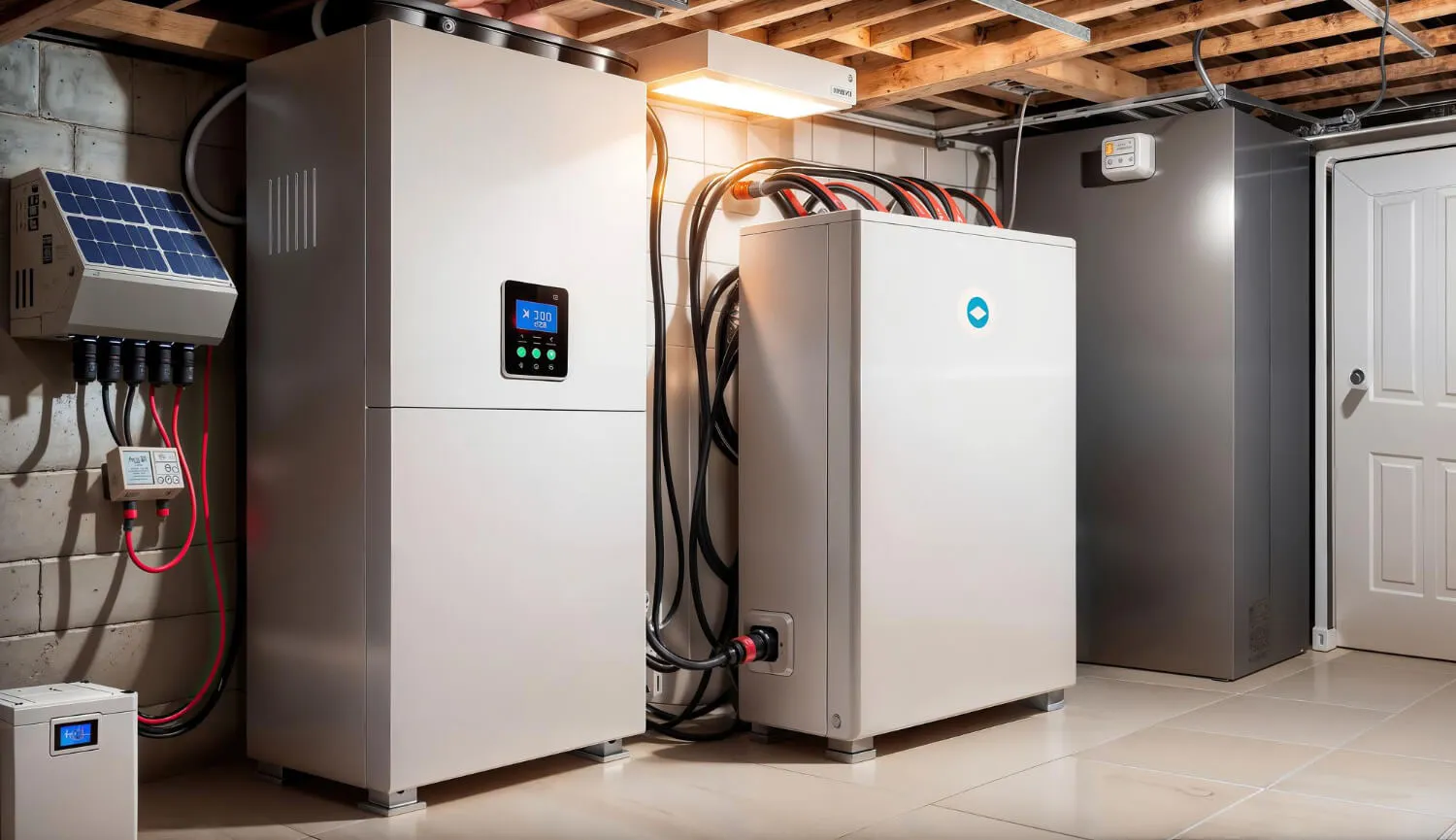
The honest answer: it depends on what you’re running. A single Powerwall 3 can last 33 hours on essential loads or burn through its charge in under 4 hours if you’re running central AC. That’s not a flaw in the technology. It’s just physics.
According to the U.S. Energy Information Administration, American customers averaged 11 hours without power in 2024, with hurricanes responsible for 80% of all lost power hours (EIA). In NC, most outages fall well within the range a single properly managed battery can handle.
This guide gives you the numbers to work out your specific situation: what your appliances draw, how long common battery sizes last on different load combinations, and how solar recharging changes the math entirely.
Key takeaways
- A Powerwall 3 (13.5 kWh) lasts 9-33 hours depending on what you run, without solar recharging
- Most NC outages from thunderstorms and ice storms resolve within hours to a few days. A managed single battery covers most of them.
- Solar recharging can make a single battery last indefinitely if some sun returns each day
- An essential loads sub-panel is the most practical way to stretch a single battery to 24+ hours
- The federal residential battery tax credit expired for new installs after 2025. Duke Energy PowerPair is the utility incentive to verify for qualifying solar-plus-battery projects.
How does battery runtime work?
The math is simpler than it sounds. Your battery holds a fixed amount of energy, measured in kilowatt-hours (kWh). Your appliances consume power at a rate measured in watts (W) or kilowatts (kW). Divide the first by the second and you get runtime in hours.
A Powerwall 3 holds 13.5 kWh. If you’re drawing 450 watts (0.45 kW) of combined load, that’s 13.5 divided by 0.45, which equals 30 hours. Draw more power and the hours shrink. It’s the same relationship as a gas tank and fuel economy: the harder you push, the faster it empties.
The load scenarios in this guide are built from manufacturer wattage specs and typical NC home consumption patterns. They’re approximations. Your actual runtime will vary based on appliance age, thermostat settings, and how often high-draw items like well pumps or microwaves cycle on.
One nuance worth knowing: starting surges. Appliances with motors (refrigerators, AC units, well pumps) draw 2-3x their running wattage for a fraction of a second when they start. Your battery’s peak output rating handles this. But surges are so brief they don’t meaningfully change average runtime calculations. What matters for runtime is the running wattage.
What do your appliances actually use?
Most people underestimate how efficient their everyday devices are and overestimate how much AC costs to run. Here’s what common NC home appliances draw:
| Appliance | Running watts | Starting surge |
|---|---|---|
| Refrigerator | 100-150W | 400W |
| LED lights (8-10 bulbs per room) | 80-100W | None |
| Wi-Fi router and modem | 10-15W | None |
| Smartphone charging | 15-25W per phone | None |
| Laptop | 30-65W | None |
| Television (55” LED) | 80-120W | None |
| CPAP machine (no heat) | 30-60W | None |
| Microwave | 900-1,200W | None (short bursts) |
| Window AC (5,000 BTU) | 500W | 900W |
| Window AC (10,000 BTU) | 900W | 1,500W |
| Central AC (3-ton) | 3,000-5,000W | Higher |
| Electric water heater | 4,500W | None |
| Well pump (1/2 HP) | 750W | 1,500W |
| EV charger (Level 1) | 1,440W | None |
A few things stand out. Your refrigerator is remarkably efficient. Your central AC is not. If you plan to run central air during an outage, that single appliance drives most of your battery sizing decision. Everything else is nearly noise by comparison.
In our NC installations, homeowners are consistently surprised that their essential loads (refrigerator, lights, Wi-Fi, phones, CPAP) add up to only 350-450 watts total. That’s less than a single window AC unit.
How long will each battery size last?
The table below shows runtime estimates for six load scenarios across the three battery sizes most commonly installed in NC homes. No solar recharging is assumed.
The three batteries:
- Tesla Powerwall 3: 13.5 kWh usable, 11.5 kW continuous (Tesla)
- FranklinWH aPower 2: 15 kWh per unit, 10 kW continuous (FranklinWH)
- Enphase IQ Battery 5P x2: 10 kWh combined, 7.68 kW combined (Enphase)
| Load scenario | Approx. draw | Powerwall 3 (13.5 kWh) | FranklinWH aPower 2 (15 kWh) | 2x Enphase IQ 5P (10 kWh) |
|---|---|---|---|---|
| Essential loads: fridge + 5 LED lights + Wi-Fi + 2 phones + CPAP | ~400W | ~33 hrs | ~37 hrs | ~25 hrs |
| Comfortable: add laptop + TV | ~600W | ~22 hrs | ~25 hrs | ~17 hrs |
| Comfortable + window AC (5,000 BTU) | ~1,100W | ~12 hrs | ~14 hrs | ~9 hrs |
| Comfortable + window AC (10,000 BTU) | ~1,500W | ~9 hrs | ~10 hrs | ~7 hrs |
| Comfortable + central AC (3-ton) | ~4,000W | ~3.5 hrs | ~4 hrs | ~2.5 hrs |
| Comfortable + well pump (avg. 30 min/hr cycling) | ~975W | ~14 hrs | ~15 hrs | ~10 hrs |
These are estimates, not guarantees. A ten-year-old refrigerator compressor draws more than a new one. A poorly insulated house makes the AC work harder. The numbers give you a reasonable planning range.
Also notice the well pump row. A half-horsepower pump running intermittently at 30 minutes per hour averages about 375 watts of additional draw. It’s significant, but manageable. If you’re on a well, factor it in from the start.
How does solar recharging change the math?
This is where home batteries get genuinely different from any other backup power solution. With solar panels feeding the system during daylight hours, a battery doesn’t have a fixed runtime. It has a daily energy budget that refreshes as long as the sun comes back.
A 5 kW solar array in NC produces roughly 20-30 kWh on a clear day, varying by season: closer to 20 kWh in December, closer to 30 kWh in June (based on NREL PVWatts data for NC). That’s enough to fully recharge a drained Powerwall 3 in 4-6 hours of good sun, with energy left over to power your home during the day. On a cloudy day, the same array produces 5-10 kWh, enough to slow depletion or partially top up before dark.
Here’s a concrete example. Say you’re running essential loads at 400W average. That’s 9.6 kWh consumed overnight (16 hours of darkness). Your 5 kW solar array on a partly cloudy day produces 8 kWh. You wake up with the battery at roughly the same level it was the night before. Not full, but not empty either. That math repeats every day the sun comes back.
With solar, the battery runtime question changes from “how many hours do I have?” to “will the sun come back before I run out?” For most NC outage scenarios, it does.
Without solar, the battery is a fixed reserve. You spend it and it’s gone until grid power returns. That’s still useful for the vast majority of NC outages. But it’s a fundamentally different tool.
For solar installation options and costs, see the solar installation page.
How long do NC outages actually last?
Understanding typical outage duration matters as much as understanding battery capacity. A battery sized for a multi-week hurricane is overkill for a typical summer thunderstorm outage that clears in a few hours.
Duke Energy’s restoration timelines vary significantly by cause and geography. Coastal and mountain NC homeowners face meaningfully different risk profiles than the Research Triangle, yet most battery sizing conversations treat all NC customers identically. Where you live should drive how much storage you actually need.
Here’s how NC outage durations typically break down by cause:
| Outage cause | Typical duration | Single Powerwall on essential loads |
|---|---|---|
| Summer thunderstorm | 1-8 hours | More than enough |
| Winter ice storm | 24-96 hours | Covers most cases with managed loads |
| Hurricane (most customers) | 3-14 days | Sufficient if solar recharges daily |
| Hurricane (worst-affected areas) | Up to 2+ weeks | Solar essential; two batteries recommended |
| Mountain flooding (like Helene) | Up to 2+ weeks | Solar essential; grid recharge unavailable |
The EIA reported that US customers averaged 11 hours without power in 2024, with hurricanes causing 80% of all lost power hours. Most everyday outages (summer thunderstorms, equipment failures, brief winter events) resolve within hours. A single managed battery covers those comfortably.
The exception is hurricane season and mountain weather. After Helene hit western NC in September 2024, some customers waited more than two weeks for restoration. For those situations, solar recharging isn’t optional. It’s what separates a battery from a very expensive flashlight.
What is an essential loads circuit, and why does it matter?
Most home battery installations in NC include an essential loads sub-panel. This is a secondary electrical panel wired to your battery that contains only the circuits you’ve chosen to protect. Everything else in your home stays dark during an outage.
This setup is how a single Powerwall 3 handles 24+ hours for most households. Instead of trying to power your whole house (which burns through 13.5 kWh in a few hours if central AC is running), you power only what actually matters.
Common essential loads sub-panel selections:
- Refrigerator circuit
- One or two lighting circuits (kitchen, main bedroom, hallway)
- Router and modem outlet
- One or two charging outlets
- CPAP or other medical device outlet
- Well pump circuit (if applicable)
What typically stays off: central AC, electric water heater, electric range, EV charger, washing machine, dryer. These are loads with workarounds (you can cook on a gas grill, skip laundry for a day) or loads that consume so much energy they’d empty the battery in hours.
Some homeowners add a window AC to their essential loads panel for one room. A 5,000 BTU unit drops a Powerwall from 33 hours to about 12 hours on essential loads. That’s still enough for most overnight outages. Whether it’s worth it is a personal call.
For more on how the battery connects to your home and what your installer sets up, see the battery storage page.
What size battery do you actually need?
Use this as a starting point. Your installer will refine it based on your actual usage data and what you want to protect.
| Coverage goal | Recommended setup |
|---|---|
| 24-hour essential loads, no solar | 1 battery (13.5-15 kWh) |
| 48-72 hour essential loads, no solar | 2 batteries (~27-30 kWh) |
| Multi-day coverage with solar, managed loads | 1 battery + 5+ kW solar |
| Multi-day with solar, including window AC | 1-2 batteries + 5+ kW solar |
| Whole-home including central AC, short outages | 2-3 batteries, or battery + generator |
| Hurricane season, no solar | 2+ batteries, or consider a generator |
If you have solar or are adding it, one battery goes a long way. Without solar, sizing for extended hurricane coverage without managing your loads pushes you toward two batteries or a battery-plus-generator approach. See the battery backup vs. generator guide for how those two options compare on cost and coverage.
The FranklinWH aPower 2’s 15 kWh gives you about 10-15% more runtime than a Powerwall 3 across every scenario above. That’s meaningful but rarely decisive on its own. The Enphase IQ Battery 5P is stackable in single-unit increments, which suits homeowners who want to start small and add capacity over time. Just confirm upfront that your installation is wired for expansion.
Duke Energy PowerPair and 2026 incentives
PowerPair is the Duke Energy incentive to understand if you are installing solar and battery together for the first time, but it is not safe to assume in a 2026 quote. Duke lists one-time incentives for qualifying battery and solar capacity, but eligibility depends on program rules, Trade Ally installation, rider enrollment, and available capacity (Duke Energy).
As of June 2026, Duke Energy Progress capacity is exhausted and Duke Energy Carolinas is at or near its cap. Ask a Duke Energy Trade Ally to confirm whether a reservation or remaining application path exists before relying on PowerPair in your budget.
For the full PowerPair details, see the Duke Energy PowerPair guide.
One important update for 2026: the federal residential clean energy credit (Section 25D) that covered battery storage costs expired for new installs after 2025. Batteries installed in 2026 should not be quoted with that credit unless a tax professional confirms a specific exception.
The program requires solar and battery installed together for the first time. You can’t add a battery to an existing solar system and assume it will qualify. Pairing solar and battery can also provide solar recharging during outages, as long as the system is designed for backup operation.
Ready to figure out what size makes sense for your home? Get a battery storage quote and we’ll walk through your actual load data and outage history.